When you start a business, work with companies, or even check whether a business is genuine, you often come across terms like CIN, LLPIN, PAN, and GST.
These numbers may look confusing, but each one serves a very specific purpose.
In this article, I’ll clearly explain the difference between CIN, LLPIN, PAN & GST, why they exist, and who needs which one—without legal jargon.
Why Are These Numbers Important?
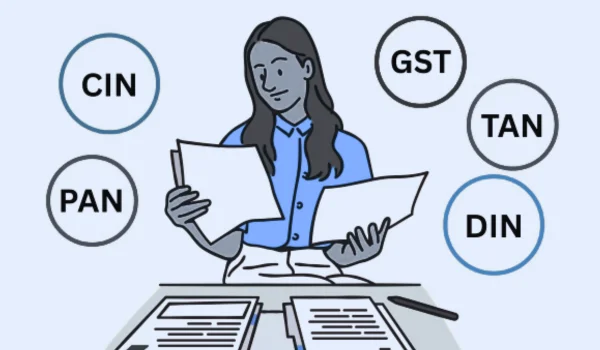
India’s business system works on identification and compliance.
Each number helps the government:
- Identify a business
- Track taxes
- Monitor legal compliance
- Prevent fraud
For business owners and common people, these numbers help in verification, trust, and transparency.
1️⃣ What Is CIN (Corporate Identification Number)?
CIN is the Company Identification Number issued to companies registered under the Companies Act, 2013.
Key Points About CIN:
- Issued by Registrar of Companies (RoC)
- Only for companies, not LLPs or sole proprietors
- Given at the time of company incorporation
Example of CIN:
U74999MH2023PTC123456
Who Needs CIN?
✔ Private Limited Company
✔ Public Limited Company
✔ One Person Company
✔ Section 8 Company
👉 CIN proves that a company legally exists in India.
2️⃣ What Is LLPIN (Limited Liability Partnership Identification Number)?
LLPIN is issued to businesses registered as Limited Liability Partnerships (LLPs).
Key Points About LLPIN:
- Issued by Ministry of Corporate Affairs (MCA)
- Only for LLPs
- Companies do NOT get LLPIN
Example of LLPIN:
AAA-1234
Who Needs LLPIN?
✔ LLP businesses
✔ Professional firms (CA, CS, Law firms registered as LLP)
👉 If a business has LLPIN, it means it is not a company, but an LLP.
3️⃣ What Is PAN (Permanent Account Number)?
PAN is a tax identification number issued by the Income Tax Department.
Key Points About PAN:
- Mandatory for almost all businesses and individuals
- Used for income tax purposes
- Required to open bank accounts and file returns
Example of PAN:
ABCDE1234F
Who Needs PAN?
✔ Individuals
✔ Companies
✔ LLPs
✔ Firms
✔ Trusts
👉 PAN is the financial identity of a person or business.
4️⃣ What Is GST (Goods and Services Tax Number)?
GSTIN is issued to businesses registered under the GST Act for tax collection.
Key Points About GST:
- Mandatory only if business crosses turnover limit or does taxable supply
- Issued by GST Department
- Linked with PAN
Example of GSTIN:
07ABCDE1234F1Z5
Who Needs GST?
✔ Businesses selling taxable goods or services
✔ Online sellers
✔ Exporters / Importers
👉 GST is about tax collection, not company registration.
🔍 Difference Between CIN, LLPIN, PAN & GST (Comparison Table)
| Basis | CIN | LLPIN | PAN | GSTIN |
| Issued By | RoC (MCA) | MCA | Income Tax Dept. | GST Dept. |
| For Whom | Companies | LLPs | All entities | GST-registered businesses |
| Purpose | Legal identity of company | Legal identity of LLP | Tax identification | Indirect tax |
| Mandatory | Yes for companies | Yes for LLPs | Yes for most | Only if applicable |
| Format | 21 characters | 7 characters | 10 characters | 15 characters |
Can One Business Have All These Numbers?
Yes, depending on its structure.
Example:
A Private Limited Company may have:
✔ CIN (company identity)
✔ PAN (tax identity)
✔ GST (if taxable turnover exists)
An LLP may have:
✔ LLPIN
✔ PAN
✔ GST (if applicable)
Common Confusion Explained Simply
- CIN ≠ PAN → CIN shows legal registration, PAN shows tax identity
- LLPIN ≠ CIN → LLPIN is for LLPs, CIN is for companies
- GST ≠ Company Registration → GST is tax-related, not legal formation
Why This Knowledge Matters for Common People
Understanding the difference helps you:
✔ Identify fake or unregistered businesses
✔ Verify employers and vendors
✔ Avoid fraud while investing or shopping online
✔ Run your own business correctly
Even before paying money to a company, checking CIN or LLPIN + PAN/GST is a smart move.
Final Conclusion
To sum it up simply:
- CIN = Identity of a Company
- LLPIN = Identity of an LLP
- PAN = Tax identity of a person or business
- GST = Tax registration for selling goods/services
Each number has a different role, and none of them replace the other.