Whether you are starting your first company, helping a client with paperwork, or simply curious about business processes in India, you may have come across the term “company registration letter.” But what exactly is it? Why is it important? How do you draft one? And where is it used?
In this detailed guide, we will answer all your questions about a company registration letter—in a clear, practical, and engaging way that every Indian can understand.
📌 What Is a “Company Registration Letter”?
A Company Registration Letter is a written communication that confirms or requests information related to the registration of a company. It may be issued by a government authority, a professional (like a lawyer, chartered accountant, or company secretary), or the applicant himself.
In simple terms:
👉 It is a formal letter used to communicate about company registration matters, such as:
✔ Confirmation of registration
✔ Request for documents
✔ Submission of details
✔ Acknowledgement to authorities
✔ Communication with service providers
While it is not a specific government document issued under Indian law, it plays an important role in the company registration process and related correspondence. It helps ensure clarity, record-keeping, and legal compliance.
🧠 Who Uses a Company Registration Letter?
These letters are typically used by:
📌 Prospective business owners
📌 Chartered Accountants (CAs)
📌 Company Secretaries (CS)
📌 Advocates/Lawyers
📌 Business consultants
📌 Banks and financial institutions
📌 Government departments
A company registration letter can be used in many stages of the company formation process—especially when communicating with the Ministry of Corporate Affairs (MCA), Registrar of Companies (RoC), banks, or other stakeholders.
🗂️ When Is a Company Registration Letter Required?
Here are common scenarios where a company registration letter might be used:
📌 1. Requesting Name Approval
Before registering a company, you must first get the proposed company name approved by the MCA.
A company registration letter may be drafted to request name approval.
📌 2. Submitting Documents
When submitting documents like Memorandum of Association (MOA), Articles of Association (AOA), identity proofs, etc., a letter may be attached to explain the submission.
📌 3. Seeking Clarification from Authorities
If MCA or RoC asks for clarification or additional information, a company registration letter is used to respond.
📌 4. Communicating with Bank or Service Providers
Banks often require letters confirming company registration for opening accounts, credit facilities, etc.
📌 5. Internal Communication
It may also be used for communication between promoters or partners regarding the registration process.
📌 Why Is a Company Registration Letter Important?
Even though digital systems like SPICe+ are widely used today, a company registration letter still matters because:
✔ It creates a formal record
✔ It helps avoid misunderstandings
✔ It provides proof of communication
✔ It can clarify intent and context
✔ It enhances professionalism
In legal and compliance matters, written communication holds value even in a digital world.
🧠 Types of Company Registration Letters
Here are some common types:
📨 1. Application for Name Approval
Used to request approval of company name from MCA.
📨 2. Submission of Registration Documents
Accompanies the submission of incorporation documents.
📨 3. Request for Clarification
When RoC asks for information, this letter responds.
📨 4. Confirmation of Registration
Issued by consultants to confirm successful registration.
📨 5. Communication to Bank for Opening Account
Used to confirm status of registration to the bank.
Each of these letters serves a specific purpose and follows a structured format.
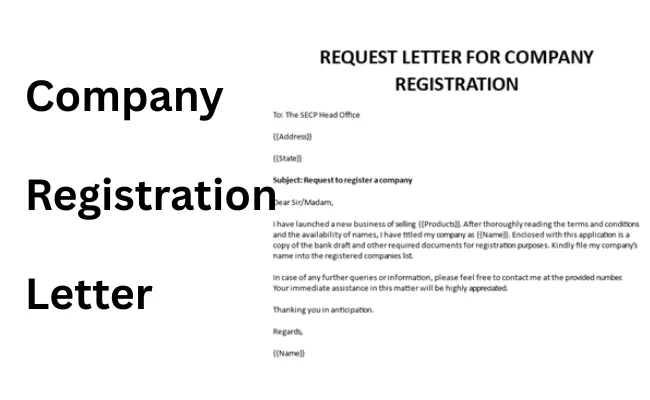
📋 Sample Structure of a Company Registration Letter
A well-structured company registration letter typically includes:
- Sender’s address
- Date
- Recipient’s address
- Subject
- Salutation
- Body of the letter
- Attachments/Enclosures
- Signature
- Designation
- Company seal (if applicable)
Let’s understand each part in detail.
🧾 How to Write a Company Registration Letter (Step by Step)
Here’s a clear guide on how to write one:
📌 1. Sender’s Address
Write your full address at the top left corner.
Example:
From:
Rajesh Kumar
123, Sector 56
Noida, Uttar Pradesh – 201301
Mobile: +91-XXXXXXXXXX
Email: rajesh@domain.com
📅 2. Date
Mention the date of writing.
Example:
Date: 25th December 2025
🏢 3. Recipient’s Address
Example:
To:
The Registrar of Companies
Ministry of Corporate Affairs
Shastri Bhawan, New Delhi – 110001
📝 4. Subject
Write a clear subject line.
Example:
Subject: Request for Company Name Approval
🙋 5. Salutation
Example:
Respected Sir / Madam,
📜 6. Body of the Letter
This is the most important part. Be clear, concise, and polite.
Example:
I, the undersigned, Rajesh Kumar, hereby submit an application for the approval of the proposed company name “Green Harvest Agro Private Limited”.
The proposed company will engage in agricultural supply and distribution services. All relevant details and documents have been attached for your reference and kind consideration.
Kindly approve the proposed name at the earliest and inform us of the next steps.
📎 7. Attachments/Enclosures
Mention what you have attached.
Example:
Enclosures:
- Name approval form
- Identity proof
- Address proof
✔ 8. Signature & Designation
Example:
(Signature)
Rajesh Kumar
Director
Mobile: +91-XXXXXXXXXX
Email: rajesh@domain.com
📌 Sample Company Registration Letter — Full Version
Here’s a complete sample you can use as a reference:
From:
Shweta Enterprises
Plot No. 257, Sector 15
Gurugram, Haryana – 122001
Mobile: +91-XXXXXXXXXX
Email: shweta@businessmail.com
Date: 5th January 2026
To:
The Registrar of Companies
Ministry of Corporate Affairs
Shastri Bhawan, New Delhi – 110001
Subject: Request for Company Name Approval – Shweta Agri Ventures Private Limited
Respected Sir / Madam,
With due respect, I, Shweta Verma, on behalf of the proposed company Shweta Agri Ventures Private Limited, hereby submit this application requesting approval for the proposed company name.
The main business activity of the proposed company will be agricultural product distribution and supply chain management. The details of the promoters and proposed directors have been provided in the attached documents.
Kindly consider and approve the proposed name in accordance with the relevant provisions of the Companies Act, 2013. We have enclosed all the necessary documents along with this letter for your kind perusal.
We humbly request you to process the name approval and issue further instructions regarding the next steps in the company registration process.
Thanking you in anticipation.
Enclosures:
- Form INC-1
- Identity & Address Proof of Promoters
- Consent of Directors
- Proposed MOA & AOA
(Signature)
Shweta Verma
Director
Shweta Enterprises
Mobile: +91-XXXXXXXXXX
Email: shweta@businessmail.com
📈 When Is a Company Registration Letter Used Today?
Even with digital filing systems like SPICe+ and online forms on the Ministry of Corporate Affairs (MCA) portal, a letter may still be required in situations such as:
✔ When responding to queries from the Registrar of Companies
✔ When attaching explanatory notes with documents
✔ When granting authority to a professional
✔ When communicating with banks or third parties
✔ When submitting correspondence that requires human review
This remains relevant especially in legal and formal contexts where clear written communication is necessary.
🧠 Tips for Writing an Effective Company Registration Letter
Here are some best practices:
🟢 Be Clear and Polite
State your purpose in simple language.
🟢 Provide Complete Information
Missing details may delay the process.
🟢 Attach Relevant Documents
Mention what you’ve attached.
🟢 Review for Errors
Spelling and grammar mistakes reduce professionalism.
🟢 Keep Copies
Always keep a signed copy for your records.
📌 Common Mistakes to Avoid
❌ Not mentioning the correct reference number
❌ Writing long, unstructured letters
❌ Forgetting to attach documents
❌ Addressing to the wrong authority
❌ Not signing the letter
Avoiding these mistakes keeps your communication smooth and efficient.
🛡️ Legal & Practical Importance
A company registration letter may not always be mandatory, but it often serves as proof of intent, formal request, or communication trail. In legal disputes or future audits, this letter can show that you acted professionally and transparently.
📊 Company Registration in the Digital Age
With digital transformation in India, most company registration processes are now completed online through:
📍 MCA Portal (mca.gov.in)
📍 SPICe+ forms
Even in digital submissions, attaching a well-crafted company registration letter can help officials understand your intent faster.
🧠 Quick Summary
✔ A company registration letter is a formal business communication
✔ It is used during the company formation process
✔ It helps convey requests, confirmations, or clarifications
✔ It must be clear, structured, and professional
✔ It is still relevant even in the age of digital filings
📌 Final Thoughts
A company registration letter may seem like a small document, but it plays a big role in ensuring smooth communication between business owners, authorities, and institutions.
Whether you’re registering your first company or helping someone with legal filings, this letter can significantly make the process efficient and professional.