If you’ve ever looked at a company’s certificate, invoice, or official communication and seen a long alphanumeric code — you might have wondered: What is this number? Why does it matter? Is it important for me?
This comprehensive article explains what a company registration number is in India, why it exists, how it’s structured, where to find it, and why it’s important for everyone — not just business owners.
🔎 What Is a Company Registration Number?
In India, the Company Registration Number refers to a unique code assigned to every company when it is legally formed (incorporated) under the Companies Act, 2013. This number is officially known as the Corporate Identification Number (CIN). It is a unique 21-digit alphanumeric code that acts as the identity of the company.
Think of it like a birth certificate number or Aadhaar number — but for companies. It tells the world that a company is legally registered with the Government of India and helps people find trustworthy information about that company
🏛️ Who Gives the Company Registration Number?
When a business incorporates as a company, the Registrar of Companies (RoC) under the Ministry of Corporate Affairs (MCA) assigns the Company Registration Number. India has multiple RoC offices in different states, and whichever office handles your company’s registration issues the unique CIN.
📌 Who Gets a Company Registration Number in India?
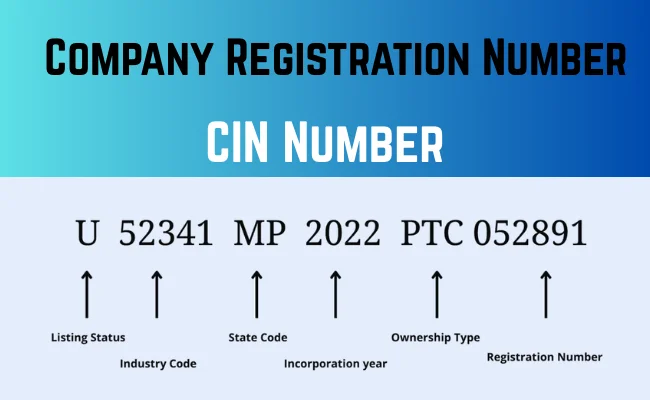
The CIN is issued to companies that register under the Companies Act 2013 and include:
✔ Private Limited Companies
✔ Public Limited Companies
✔ One Person Companies (OPCs)
✔ Section 8 (Not-for-Profit) Companies
✔ Government Companies
✔ Nidhi and other registered company types
However, it is not issued to certain other types of entities such as:
❌ Sole Proprietorship
❌ Partnership Firms (traditional ones)
❌ Certain trusts and societies
❌ Limited Liability Partnerships (LLPs) — which instead get an LLPIN (Limited Liability Partnership Identification Number)
🧩 Structure of the Company Registration Number (CIN)
A company’s registration number is not just random. Each part of the 21 characters contains specific information about the company’s identity and origin.
Here is an easy-to-remember breakdown:
Sample Company Registration Number Example
U12345MH2024PTC012345
Let’s decode it step by step:
| Section | What It Means |
| U / L | Indicates whether the company is Unlisted (U) or Listed (L) on the stock exchange. |
| 12345 | Industry or economic activity code — showing what kind of business it is. |
| MH | State Code where the company was registered (e.g., MH = Maharashtra, DL = Delhi). |
| 2024 | Year of incorporation — when the company was legally formed. |
| PTC | Company type — PTC = Private Company, PLC = Public Company, etc. |
| 012345 | Six-digit unique registration number issued by the RoC. |
So, from the above company registration number example, you can tell:
- Whether it’s a listed or unlisted company
- Where it was incorporated
- When it was registered
- What type of company it is
- Its unique registration sequence number
This makes every CIN truly unique and traceable.
📄 Where You Can Find the Company Registration Number
The company registration number (CIN) is mentioned in many important places, including:
✔ Certificate of Incorporation
✔ MCA Official Database (online)
✔ Company’s Letterheads
✔ Invoices and Receipts
✔ Official Emails and Notices
✔ Annual Reports and Audit Documents
✔ Public Filings on the MCA Portal
To find a company’s CIN yourself, you can use the MCA portal search by entering the company name — the system will show its CIR and details.
📈 Why the Company Registration Number Is Important
✔ 1. Legal Validation
The CIN proves that the company registered is legitimate and recognized by the Government of India. If a business does not have a CIN, it means it may not be a registered company.
✔ 2. Mandatory for Compliance
According to the Companies Act, a company must print its CIN on all official documents — including bills, letterheads, notices, and annual reports. Failing to do so can lead to penalties.
✔ 3. Ease of Verification
Anyone — investors, customers, suppliers, banks — can check company details using the CIN. You can find things like:
- Registered address
- Date of incorporation
- Financial filings
- Active or inactive status
This boosts transparency and trust.
✔ 4. Helps Regulatory Tracking
Government departments use the CIN to monitor ongoing compliance by companies — such as periodic financial reporting, taxation, and statutory filings.
🧠 Real-Life Use Cases for Common People
Even if you’re not a business owner, knowing the company registration number helps you:
📌 Verify legitimacy before paying money online
📌 Check the age and history of a company
📌 Understand if the company is a public or private entity
📌 Avoid frauds and shady firms
📌 Know the state of registration and year of establishment
🔥 What Happens if the CIN Is Not Mentioned
If a company fails to mention its company registration number on stationery, financial statements, filings, and statutory communications, it is liable for penalties under the MCA rules — typically around ₹1,000 per day, up to a maximum prescribed limit.
🧭 Difference Between CIN and Other Business Numbers
Many people hear about numbers like GSTIN, PAN, and LLPIN and get confused. But remember:
- 🆔 CIN – Official ID for companies
- 🆔 LLPIN – Official ID for LLPs
- 🆔 PAN – Tax ID for individuals and businesses
- 🆔 GSTIN – Tax registration for goods/services
So, CIN is about the legal identity as a company, not about tax registration or LLP identity.
📌 Final Summary — In Simple Words
- Company Registration Number India = same as Corporate Identification Number (CIN).
- It is a 21-digit unique code given to companies registered in India.
- Every part of the number reflects meaningful details about the company’s status, state, type, and registration.
- CIN is mandatory, used for verification, compliance, and regulatory tracking.
📌 A Quick Company Registration Number Example Decoded
Let’s take a sample company registration number:
L85110KA1981PLC013115
✔ L = Listed company
✔ 85110 = Industry code
✔ KA = Karnataka state
✔ 1981 = Year of incorporation
✔ PLC = Public Limited Company
✔ 013115 = Unique registration number with RoC
This single number tells you a company’s status, age, type, and origin — all in one shot!